Home / The Injection Room / How did one clinic cut its charting time to under five minutes without losing any detail?
case study
How did one clinic cut its charting time to under five minutes without losing any detail?
A three injector practice rebuilt its treatment record around capture at the chair. The change was sequence, not software: consent, lot and photo before the first needle.
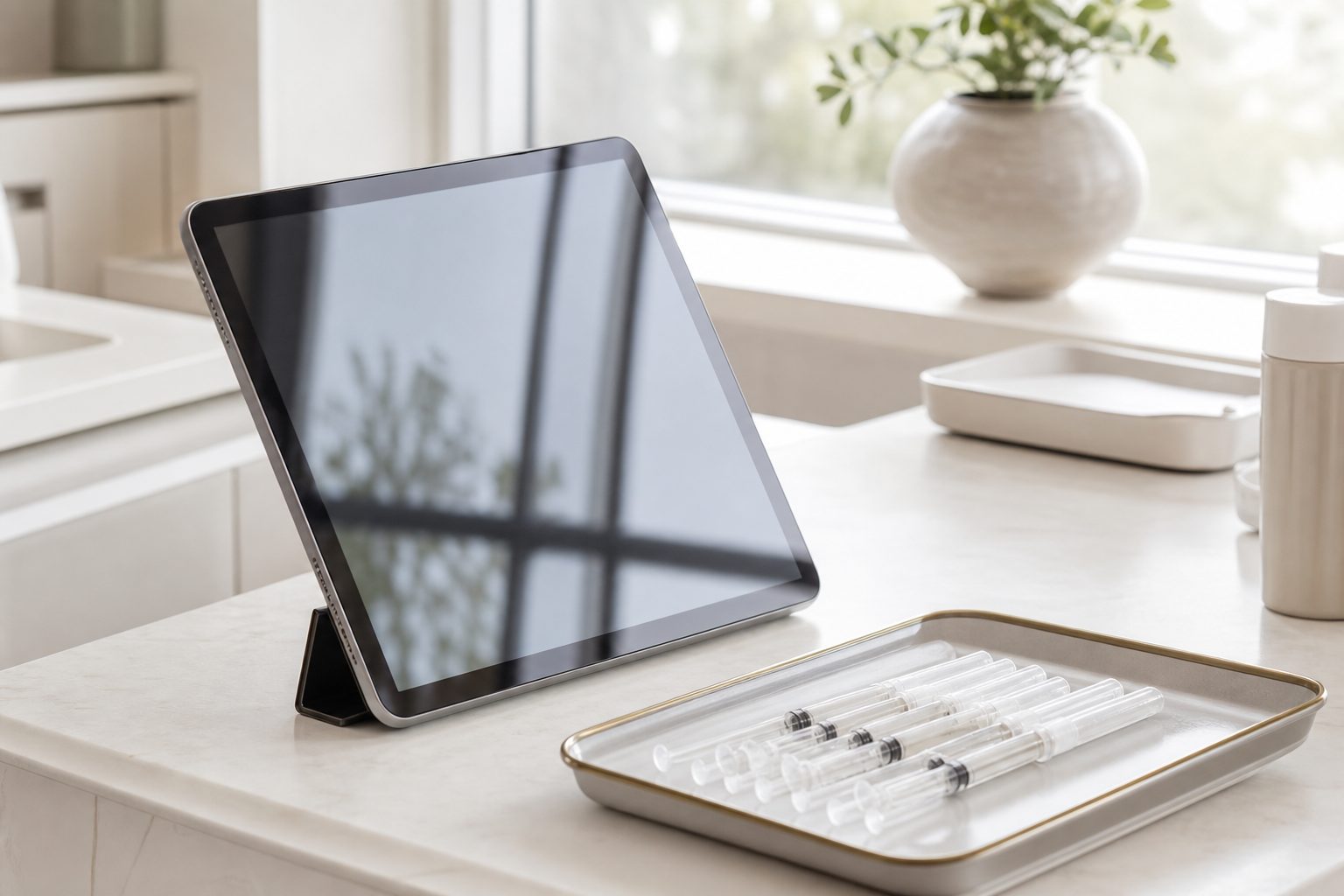
The short answer is that they stopped charting after the treatment and started charting during it. A three injector practice that had been finishing notes at home moved consent, photography and lot capture to the front of the appointment, before the syringe was ever drawn up. Nothing was removed from the record. The order changed, and the order was what had been costing them the time.
This is a composite account drawn from a common pattern rather than a named clinic, and the timings below are the practice's own stopwatch numbers from their internal review, not a study. But the sequence is transferable, and the specific failures they hit in month one are the ones most practices hit.
The result they cared about was not speed. It was completeness. A four minute note that contains the lot number is worth more than a fifteen minute narrative that does not.
The starting point: charts finished after close, some never finished
Three injectors, one shared front desk, roughly sixty patients a week. Consent forms were paper, signed at the front desk, scanned in batches on Fridays. Photos were taken on the injector's own phone and airdropped later. Lot numbers were written on a sticky note on the tray and transcribed at the end of the day, if the sticky note survived.
When the owner audited ninety consecutive treatment records, the gaps were consistent and predictable. Consent signatures were present but often undated or dated on the scan day. Lot numbers were missing on a meaningful minority of records, and where they existed, nobody could prove which vial went to which patient when two patients were treated from the same reconstituted vial. Before photos existed for lips and cheeks and almost never for foreheads.
The injectors were not careless. They were doing every piece of documentation, just at the wrong moment, when the clinical work was already done and the next patient was already in the chair.
Keep reading: Where is state regulation of nurse injectors heading, and what should I prepare for now?
Mapping the chair side sequence minute by minute
Before changing anything, the owner sat in the corner with a timer for two full days and wrote down what actually happened. That exercise is the whole method, and it is free.
| Step | Original timing | Where the record was touched |
|---|---|---|
| Greet, seat, chat | 4 min | Nothing |
| Assessment and plan discussion | 7 min | Nothing |
| Draw up and reconstitute | 3 min | Sticky note, sometimes |
| Injection | 9 min | Nothing |
| Aftercare and rebook | 4 min | Nothing |
| Write the note | 11 to 18 min, deferred | Everything, from memory |
The deferred block was the problem. It was the only step with no patient in front of it, which made it the only step that could be pushed. And it relied entirely on recall of details that had been true twenty minutes or six hours earlier.
Moving consent and photo capture ahead of draw up
The change was a hard rule: no vial is opened until the record for that visit already contains a signed consent for the specific product and area, and a dated before photo.
Consent moved from the front desk to the chair, on a tablet, signed by the patient after the assessment conversation rather than before it. This is better clinically as well as administratively. A consent signed in the waiting room covers a treatment nobody has discussed yet. A consent signed after the injector has said the words "we are treating the glabella and the lateral canthal lines, roughly forty units total, and here is what a heavy brow would look like if it happens" is a consent that means something.
Photography moved into the same tablet session, from a marked spot on the floor with a fixed light. Two views, front and three quarter, plus animation for toxin. The photo lives attached to the visit record rather than in a camera roll.
Lot capture happened at draw up, by scanning or photographing the vial label into the same record before reconstitution. That single move eliminated the sticky note category of error entirely, because the lot was recorded at the only moment it was physically in the injector's hand.
Keep reading: What does a legally sound consent form for neuromodulator treatment actually need to include?
Recording injection sites on a face map instead of prose
The old notes read like paragraphs. "Treated glabella and forehead with standard pattern, good distribution, patient tolerated well." That sentence takes ninety seconds to compose and tells a future reader almost nothing useful.
The replacement was a face map with tap to place points, each carrying a unit or volume value. Ten to fifteen seconds of tapping produces a diagram that shows exactly where the product went and how much landed in each site.
The clinical payoff appeared within a month. When a patient came back at day fourteen with an asymmetric brow, the injector could look at the map, see that the left frontalis had received two units more than the right, and correct precisely. Under the old prose note that conversation would have started with guesswork.
What the map does that a narrative cannot
- It makes the touch up decision a measurement rather than a memory.
- It makes a second injector able to take over the patient without a phone call.
- It makes dose creep visible over time, when the same face quietly climbs from thirty two units to fifty over six visits.
- It answers the question a board investigator actually asks, which is where the product went, not how the patient tolerated it.
Where the front desk absorbs work the injector was doing
Some of the time saved was not saved. It moved.
The front desk took over intake demographics, medical history updates, medication and allergy review, photo consent for marketing use, and payment. All of that now happens before the patient enters the room, and all of it lands in the same visit record the injector opens.
The desk also took the two week recall. Rather than the injector remembering to tell someone to call, the visit record generates the touch up follow up automatically at day fourteen, and the desk works that list each morning. That change did more for revenue than for time: touch up visits that had been quietly falling through started getting booked, and the day fourteen call is also when you catch a problem while it is still small.
See how InjectConsent handles this for medical aesthetics and injectables
What broke in the first month and how they fixed it
Three things went wrong, and none of them were the software.
The tablet became a bottleneck. One device, three injectors, three rooms. On busy afternoons someone was always waiting. They bought two more tablets. The cost was trivial against the time being burned.
Consent got rushed. Because signing moved to the chair, one injector started handing the tablet over mid sentence and letting people sign while she prepped. The owner caught it on a chart review and set a rule: the tablet does not change hands until the injector has stopped talking and asked for questions. Consent that is signed in a hurry is consent that a plaintiff's attorney will characterize as no consent at all.
Photo quality drifted. Without a fixed mark on the floor, distance and angle wandered, and the day fourteen comparison was useless. They put tape on the floor and a mark on the wall at eye height. Problem solved for the price of a roll of tape.
Measuring the result against chart completeness, not speed
The owner ran the same ninety record audit again at ninety days. She scored each record against six binary criteria rather than reading them for quality of prose.
- Consent signed and dated on the treatment date, naming the product and areas.
- Product lot number and expiration recorded for every product used.
- Before photo attached, dated to the visit.
- Injection sites and doses mapped, totaling to the units or volume billed.
- Aftercare instructions issued and acknowledged.
- Follow up scheduled or declined, with the decline noted.
That scorecard is worth copying as it stands. It is objective, it takes about forty seconds per record, and it produces a percentage you can track month over month. A record that hits all six is defensible. A beautifully written record missing item two is not.
Charting time landed under five minutes because most of it was no longer a separate task. Consent, photo and lot were captured as the treatment happened. What remained at the end was the map, the aftercare confirmation and any deviation from plan, which is genuinely a short piece of writing.
If you want to try this in your own room
Start with the timer, not the tools. Two days of honest observation will tell you where your documentation is being deferred, and deferred documentation is where every gap in your records is born. Then move one thing forward: put consent at the chair, or capture the lot at draw up, and hold that rule for a month before changing anything else.
InjectConsent is built around exactly this sequence. Consent signed at the chair, lot number captured at draw up, injection sites tapped onto a face map, before photo attached to the visit, and the two week touch up recall generated without anyone remembering to create it. The record is complete when the patient stands up, which is the only time it is ever complete without effort.
Read also
More from The Injection Room

Where is state regulation of nurse injectors heading, and what should I prepare for now?
States are tightening good faith exam rules, telehealth supervision and ownership structure. The direction of travel is clear enough to plan around before it reaches your license.

What does a legally sound consent form for neuromodulator treatment actually need to include?
Informed consent for botulinum toxin rests on four elements: nature, risks, alternatives and the right to refuse. Here is how each one maps to the document you hand a patient.

How do I document product lot numbers so a recall or an adverse event does not sink me?
Lot capture is the thread connecting a vial to a patient to a manufacturer notice. This is the workflow that makes traceability survive a busy day and an FDA MedWatch report.